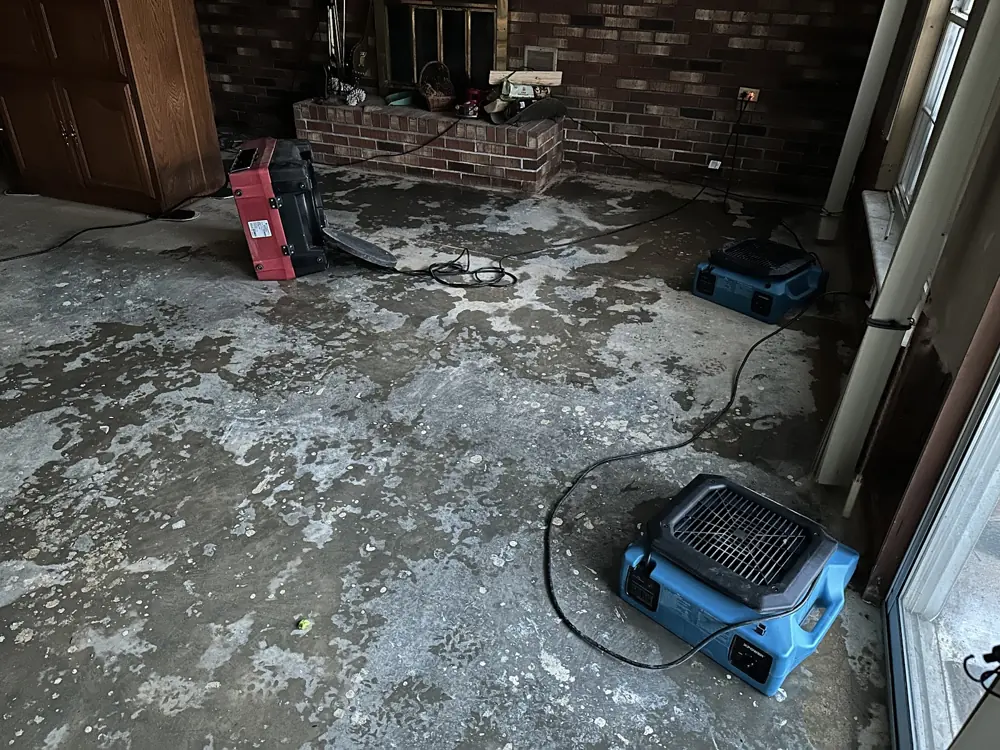
Houston's flat terrain and heavy downpours mean a garage, often the lowest and least protected slab in the house, is frequently the first place water shows up, whether from street flooding or a leaking water heater stored inside. Crews respond 24/7 to extract and dry.

A crew determines whether the water came from outside flooding, a water heater leak, or another source before starting extraction.
Standing water is pumped or extracted from the garage slab, and stored belongings are sorted to identify what can be saved versus what absorbed too much water.
The base of garage walls is checked for moisture and opened where water has tracked up into the drywall.
Air movers and dehumidifiers dry the slab and wall base until moisture readings confirm the garage is fully dry.

While help is on the way, these first steps, done only where it is safe, limit the damage and protect the insurance claim.
Shut the supply off at the source, or close the home's main valve if the source is not obvious. Stopping the flow limits the damage more than anything else.
Switch off electricity to the affected area, but only if the breaker can be reached without standing in or touching the water.
Get a crew dispatched right away. The sooner extraction and drying begin, the more flooring, drywall, and belongings can be saved.
Take photos and a short video of the water and the affected rooms before anything is moved, so the insurance claim starts strong.
Garage water damage limited to the slab and a small section of drywall, addressed within a day of the water entering, typically runs from about $500 to $1,500 to extract and dry. A garage that took on deeper standing water, damaged stored belongings, and required more drywall removal at the wall base commonly runs from about $1,800 to $4,500. Coverage depends heavily on the cause, since street or storm flooding is often excluded from a standard policy without separate flood coverage, while a sudden water heater leak is typically covered.
Crews reach Houston, Harris County, and the surrounding Gulf Coast communities fast, from the Heights, Montrose, and River Oaks to West University Place, Bellaire, Pasadena, and South Houston. See the full list on the areas served across Houston page.
See all areas servedEvery loss is photographed, measured, and logged from the first visit, so the paperwork holds up with the insurance carrier.
Technicians follow recognized IICRC drying standards and prove it with daily moisture readings on Houston homes, not guesswork.
Emergency dispatch any hour of the day or night, with a real crew on the way across Greater Houston, not a callback in the morning.
A real crew dispatched any hour, not a callback in the morning.
Trained technicians following recognized IICRC drying standards.
Truck-mounted, portable, and submersible for any size loss.
The loss is documented and billed to the carrier directly.
Garages typically sit close to street grade with a threshold offering less protection than a home's main entry, and Houston's flat terrain combined with storm drains that can be overwhelmed during intense rain lets water back up and seep under the door.
Often not, unless the homeowner carries separate flood insurance through the NFIP or a private carrier. A water heater failure or other sudden internal leak in the garage is typically treated differently and often covered.
It depends on the material and how long it sat in water. Sealed plastic totes usually protect their contents, while cardboard boxes, fabric, and paper items left in standing water typically cannot be salvaged.
Garage drywall is handled the same as living-space drywall: if it stayed wet long enough to be fully saturated, the affected section is usually removed rather than dried in place, especially near the slab where moisture concentrates.
That is a plumbing determination separate from the water damage cleanup. If the tank itself failed at a seam or fitting, replacement is typically the only option and is scheduled with a plumber.
Houston crews are on call 24 hours a day, local and fast, and can be on the way within the hour.
Call (346) 680-3171