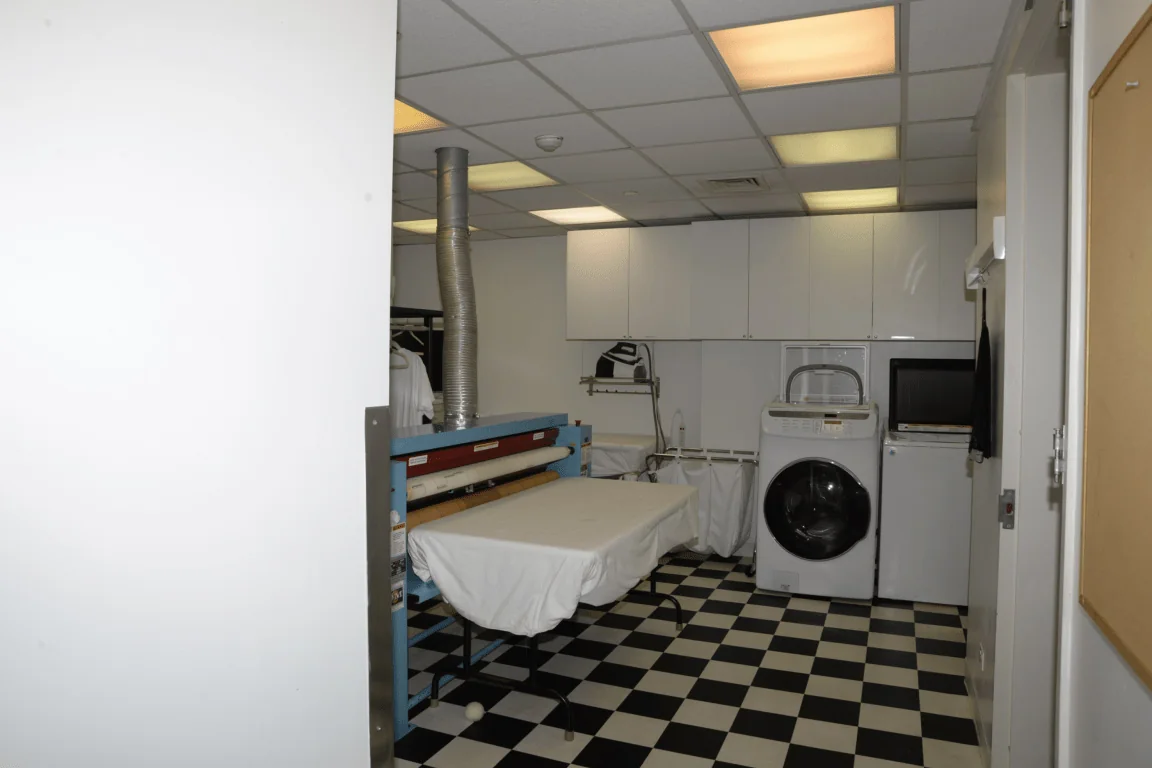
A washing machine hose failure or a stuck drain can put dozens of gallons across a laundry room floor and into whatever room sits next to it. Crews extract the water fast and check how far it traveled before it soaks into flooring or drywall.

A crew typically arrives within about an hour to confirm the washer's water supply is off and check for any remaining active leak.
Standing water is pulled from the laundry room floor and any adjoining space the water reached, working from the appliance outward.
Moisture readings are taken under the washer and dryer and along nearby baseboards, since water often pools underneath before it is visible.
Air movers and dehumidifiers dry the laundry room and any affected adjoining flooring, with moisture readings logged for the insurance claim.

While help is on the way, these first steps, done only where it is safe, limit the damage and protect the insurance claim.
Shut the supply off at the source, or close the home's main valve if the source is not obvious. Stopping the flow limits the damage more than anything else.
Switch off electricity to the affected area, but only if the breaker can be reached without standing in or touching the water.
Get a crew dispatched right away. The sooner extraction and drying begin, the more flooring, drywall, and belongings can be saved.
Take photos and a short video of the water and the affected rooms before anything is moved, so the insurance claim starts strong.
Washing machine overflow cleanup in Houston typically runs from about $300 to $2,500, depending on how long the overflow ran, whether it was a hose failure or a slower drain issue, and how far the water spread into adjoining rooms. A quickly caught overflow contained to the laundry room sits on the low end, while a supply hose failure that ran for hours and reached carpeted flooring nearby sits on the higher end. Sudden appliance failures are commonly covered under a standard homeowner's policy.
Crews reach Houston, Harris County, and the surrounding Gulf Coast communities fast, from the Heights, Montrose, and River Oaks to West University Place, Bellaire, Pasadena, and South Houston. See the full list on the areas served across Houston page.
See all areas servedEvery loss is photographed, measured, and logged from the first visit, so the paperwork holds up with the insurance carrier.
Technicians follow recognized IICRC drying standards and prove it with daily moisture readings on Houston homes, not guesswork.
Emergency dispatch any hour of the day or night, with a real crew on the way across Greater Houston, not a callback in the morning.
A real crew dispatched any hour, not a callback in the morning.
Trained technicians following recognized IICRC drying standards.
Truck-mounted, portable, and submersible for any size loss.
The loss is documented and billed to the carrier directly.
Usually, especially for a supply hose failure. A drain overflow involving used wash water is typically treated as slightly more contaminated, though not to the level of a sewage backup, and is handled with appropriate care.
Further than expected in a slab-on-grade Houston home, since there is no raised threshold to contain it. Water commonly travels under the appliance, along baseboards, and under a door into the next room.
Yes. Water can pool under the appliance base for a while before it becomes visible elsewhere in the room, which is why moisture readings are taken directly under the units rather than just around them.
Sudden hose failures and mechanical malfunctions are commonly covered under a standard homeowner's policy. A slow, long-term leak that went unaddressed may be reviewed more closely depending on the policy.
Replacing rubber supply hoses with braided stainless steel ones and avoiding running the washer while away from home for extended periods both reduce the risk, though neither eliminates it entirely.
Houston crews are on call 24 hours a day, local and fast, and can be on the way within the hour.
Call (346) 680-3171