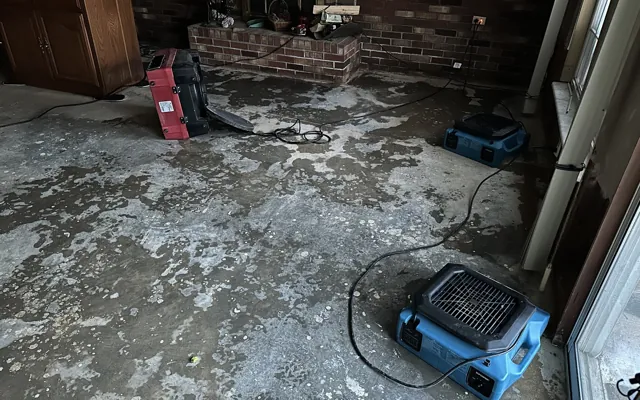
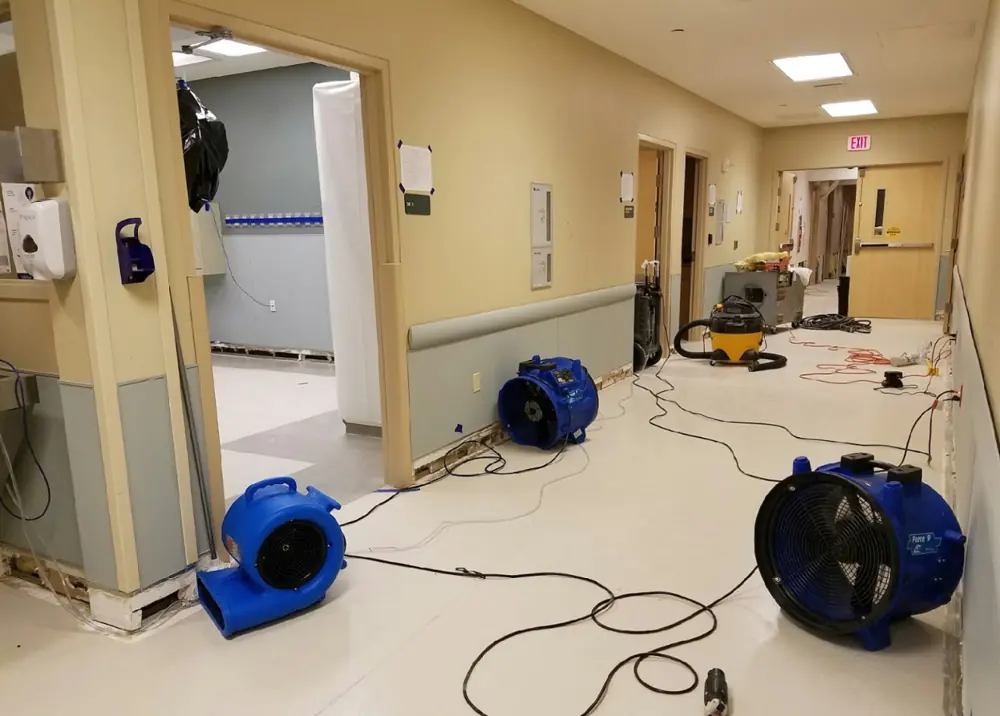
Tropical storms, hurricanes, and heavy summer downpours can push water into a Houston home faster than the ground can absorb it. Crews respond with large-scale extraction and drying equipment scaled to whatever the storm left behind, from a few wet rooms to a full-property flood.

Dispatch runs around the clock during and after a storm, with a crew assessing electrical and structural safety before anyone enters a flooded property.
Truck-mounted pumps and submersible units clear standing water across the affected footprint, prioritizing rooms with the deepest water first.
Floodwater from a bayou or storm surge is treated as contaminated, so soaked carpet, pad, and lower drywall are removed rather than dried in place.
Dehumidifiers and air movers are staged throughout the property, moisture is tracked daily, and photos and readings are compiled for flood-insurance or FEMA documentation.

While help is on the way, these first steps, done only where it is safe, limit the damage and protect the insurance claim.
Shut the supply off at the source, or close the home's main valve if the source is not obvious. Stopping the flow limits the damage more than anything else.
Switch off electricity to the affected area, but only if the breaker can be reached without standing in or touching the water.
Get a crew dispatched right away. The sooner extraction and drying begin, the more flooring, drywall, and belongings can be saved.
Take photos and a short video of the water and the affected rooms before anything is moved, so the insurance claim starts strong.
Storm and flood cleanup costs in Houston vary widely, generally from about $3,000 for a contained loss in a few rooms to well over $15,000 for a full-property flood after a major storm. Depth of water, how many rooms were affected, and whether the water was contaminated bayou or storm-surge floodwater all drive the range. Because this kind of damage is usually tied to a separate flood policy or FEMA assistance rather than standard homeowner's coverage, documentation is built specifically to support that process from the first day of cleanup.
Crews reach Houston, Harris County, and the surrounding Gulf Coast communities fast, from the Heights, Montrose, and River Oaks to West University Place, Bellaire, Pasadena, and South Houston. See the full list on the areas served across Houston page.
See all areas servedEvery loss is photographed, measured, and logged from the first visit, so the paperwork holds up with the insurance carrier.
Technicians follow recognized IICRC drying standards and prove it with daily moisture readings on Houston homes, not guesswork.
Emergency dispatch any hour of the day or night, with a real crew on the way across Greater Houston, not a callback in the morning.
A real crew dispatched any hour, not a callback in the morning.
Trained technicians following recognized IICRC drying standards.
Truck-mounted, portable, and submersible for any size loss.
The loss is documented and billed to the carrier directly.
The combination of flat, low-lying terrain, clay soil that does not absorb rain well, and a web of bayous that can overtop during heavy rain means Houston sees flooding from storms that would drain away elsewhere. Hurricane Harvey remains the most extreme example on record.
Yes. Bayou and storm-surge floodwater is treated as contaminated, so soaked porous materials like carpet, pad, and lower drywall are typically removed rather than dried, unlike a clean-water pipe failure.
Usually not on its own. Flooding from a bayou overtopping its banks or storm surge is typically a flood-insurance or FEMA matter rather than standard homeowner's coverage, so documentation is built to support that separate process.
Dispatch continues around the clock through a storm event, though road conditions and safety come first. Crews move in as soon as an area is safe to access, often the same day water starts to recede.
Storm response is scaled for exactly that, with extraction and drying equipment allocated across multiple properties and priority given to homes with active water intrusion or the deepest flooding.
Houston crews are on call 24 hours a day, local and fast, and can be on the way within the hour.
Call (346) 680-3171