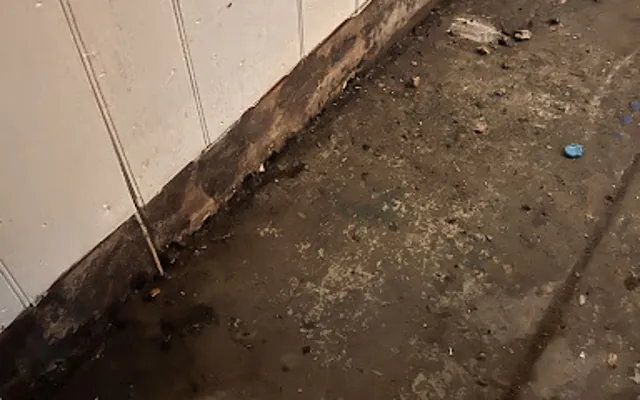
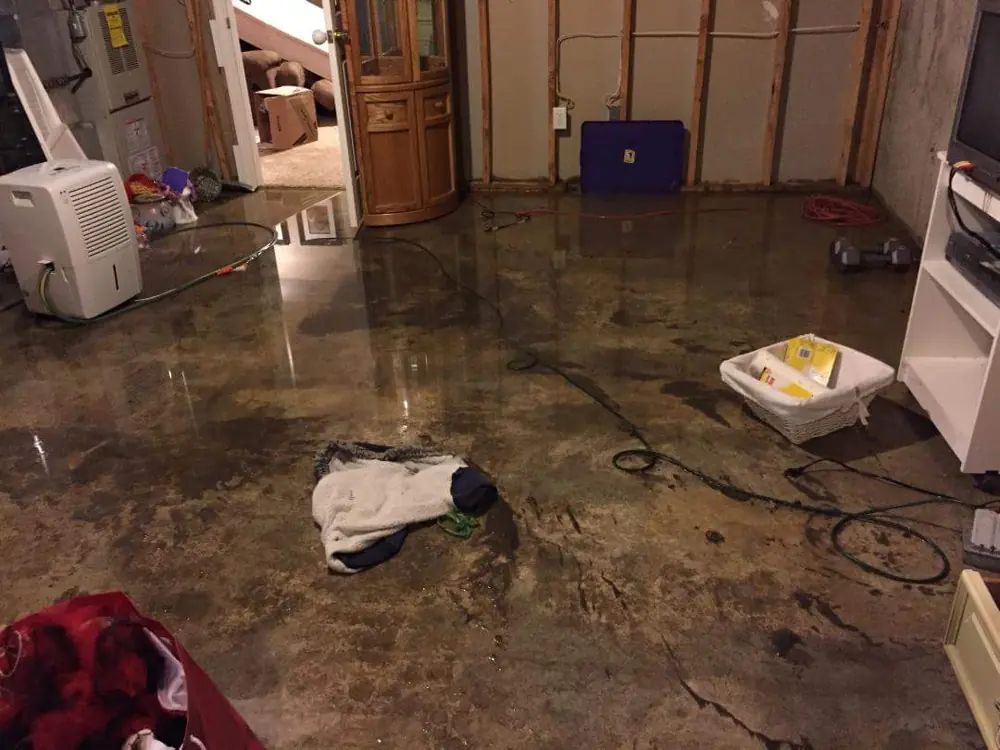
A sewage backup is treated as contaminated water from the first minute, not just a mess. Houston crews extract, remove anything porous that touched the water, and sanitize the affected area so the home is safe again, day or night.

A crew is typically on-site within about an hour, wearing protective equipment and setting up containment so contaminated water does not spread to unaffected rooms.
Submersible pumps and wet vacuums remove standing sewage water, working from the point of backup outward.
Carpet, pad, baseboards, and drywall that were in contact with the water are cut out and bagged for disposal rather than dried in place.
Affected surfaces are cleaned and treated with antimicrobial solution, then dried and moisture-verified before the space is cleared for repair work.

While help is on the way, these first steps, done only where it is safe, limit the damage and protect the insurance claim.
Shut the supply off at the source, or close the home's main valve if the source is not obvious. Stopping the flow limits the damage more than anything else.
Switch off electricity to the affected area, but only if the breaker can be reached without standing in or touching the water.
Get a crew dispatched right away. The sooner extraction and drying begin, the more flooring, drywall, and belongings can be saved.
Take photos and a short video of the water and the affected rooms before anything is moved, so the insurance claim starts strong.
Sewage backup cleanup in Houston typically runs from about $1,500 to $7,000, depending on how far the water spread, how many rooms were affected, and how much porous material has to be removed. A backup contained to a single bathroom sits on the low end, while a backup that spreads across a hallway and into carpeted rooms sits on the higher end. Sudden sewer backups are frequently covered under a homeowner's policy or a separate sewer-backup endorsement, and every step of extraction, disposal, and sanitizing is documented for the claim.
Crews reach Houston, Harris County, and the surrounding Gulf Coast communities fast, from the Heights, Montrose, and River Oaks to West University Place, Bellaire, Pasadena, and South Houston. See the full list on the areas served across Houston page.
See all areas servedEvery loss is photographed, measured, and logged from the first visit, so the paperwork holds up with the insurance carrier.
Technicians follow recognized IICRC drying standards and prove it with daily moisture readings on Houston homes, not guesswork.
Emergency dispatch any hour of the day or night, with a real crew on the way across Greater Houston, not a callback in the morning.
A real crew dispatched any hour, not a callback in the morning.
Trained technicians following recognized IICRC drying standards.
Truck-mounted, portable, and submersible for any size loss.
The loss is documented and billed to the carrier directly.
Yes. It is classified as category 3 water, meaning it can carry bacteria and other pathogens. Anything porous it touches is generally removed rather than cleaned, and the area is sanitized before anyone spends time there.
In older neighborhoods, aging sanitary lines can take on stormwater infiltration during heavy rain, and tree roots or grease buildup narrow lines over time. When the system is overloaded, the backup surfaces at the lowest drain in the house.
Rarely. Porous materials that were in contact with contaminated water are typically removed and disposed of rather than dried, because sanitizing them fully is not reliable. Hard, non-porous surfaces can usually be cleaned and kept.
Many homeowner policies include or offer a sewer and drain backup endorsement that covers this kind of loss, though coverage varies by policy. Extraction, disposal, and sanitizing are documented in detail to support whichever claim applies.
Once contaminated materials are removed and the space is sanitized, drying and moisture verification typically take a few days depending on how far the water traveled. The area is not cleared until moisture readings confirm it is fully dry.
Houston crews are on call 24 hours a day, local and fast, and can be on the way within the hour.
Call (346) 680-3171