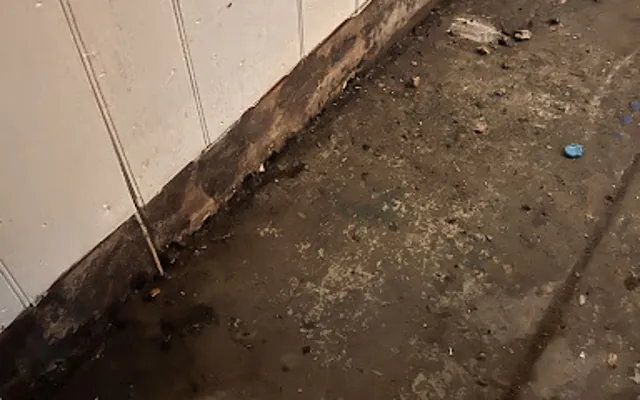
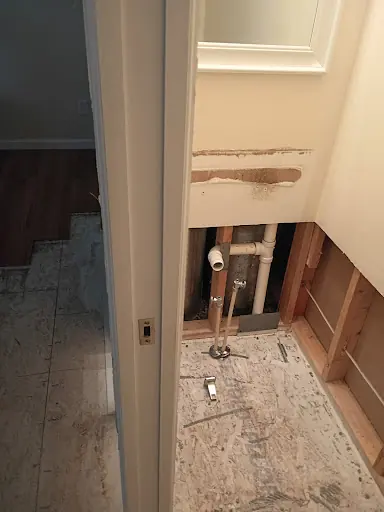
Many homes in unincorporated Harris County communities around Houston still run on septic systems rather than city sewer, and a failed drain field or overwhelmed tank can send contaminated water back into the house. Crews respond 24/7 to extract and sanitize.

A crew confirms the backup source and treats the affected area as category 3 contaminated water from the start.
Backed-up water and solid waste are extracted and disposed of according to standard contaminated-water handling practices.
Carpet, pad, baseboard, and other porous materials that absorbed septic water are removed, since they cannot be reliably sanitized.
Remaining hard surfaces are cleaned and sanitized, then dried and moisture-checked before the space is cleared as safe.

While help is on the way, these first steps, done only where it is safe, limit the damage and protect the insurance claim.
Shut the supply off at the source, or close the home's main valve if the source is not obvious. Stopping the flow limits the damage more than anything else.
Switch off electricity to the affected area, but only if the breaker can be reached without standing in or touching the water.
Get a crew dispatched right away. The sooner extraction and drying begin, the more flooring, drywall, and belongings can be saved.
Take photos and a short video of the water and the affected rooms before anything is moved, so the insurance claim starts strong.
Septic backup cleanup contained to one bathroom or utility room typically runs from about $600 to $2,000, reflecting the extra disposal and sanitizing steps contaminated water requires. A backup that reaches multiple rooms or requires removing carpet and baseboard across a larger area commonly runs from about $2,500 to $6,000. This covers cleanup and drying only, separate from any cost to pump, repair, or replace the septic tank or drain field itself, which is typically handled by a septic service provider.
Crews reach Houston, Harris County, and the surrounding Gulf Coast communities fast, from the Heights, Montrose, and River Oaks to West University Place, Bellaire, Pasadena, and South Houston. See the full list on the areas served across Houston page.
See all areas servedEvery loss is photographed, measured, and logged from the first visit, so the paperwork holds up with the insurance carrier.
Technicians follow recognized IICRC drying standards and prove it with daily moisture readings on Houston homes, not guesswork.
Emergency dispatch any hour of the day or night, with a real crew on the way across Greater Houston, not a callback in the morning.
A real crew dispatched any hour, not a callback in the morning.
Trained technicians following recognized IICRC drying standards.
Truck-mounted, portable, and submersible for any size loss.
The loss is documented and billed to the carrier directly.
No, it is not recommended. Septic backup is category 3 contaminated water and carries bacteria that make direct contact and DIY cleanup a health risk. Extraction and sanitizing should be handled with proper containment and disposal.
No. Cleanup addresses the water damage inside the home. Pumping the tank, repairing a failed drain field, or replacing septic components is separate work handled by a septic service provider.
Many unincorporated Harris County communities outside the city's sewer service area, including parts of Channelview and Aldine, rely on individual septic systems rather than municipal sewer.
No. Contaminated water that soaks into carpet, pad, or baseboard cannot be sanitized reliably, so those materials are removed and disposed of rather than dried in place.
Coverage depends on the policy and the cause. Some homeowner policies exclude or limit coverage for backups tied to a septic system's own failure, so it is worth confirming the specific policy language.
Houston crews are on call 24 hours a day, local and fast, and can be on the way within the hour.
Call (346) 680-3171