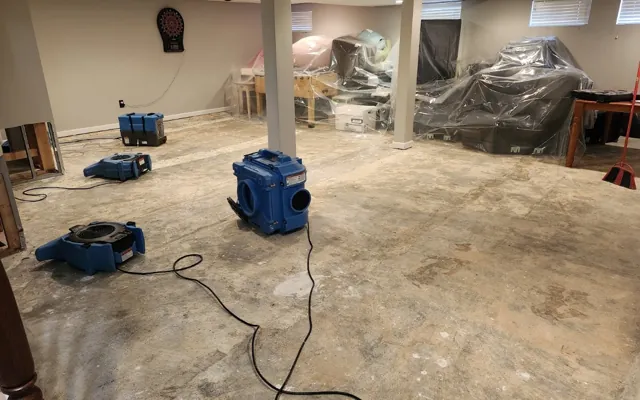
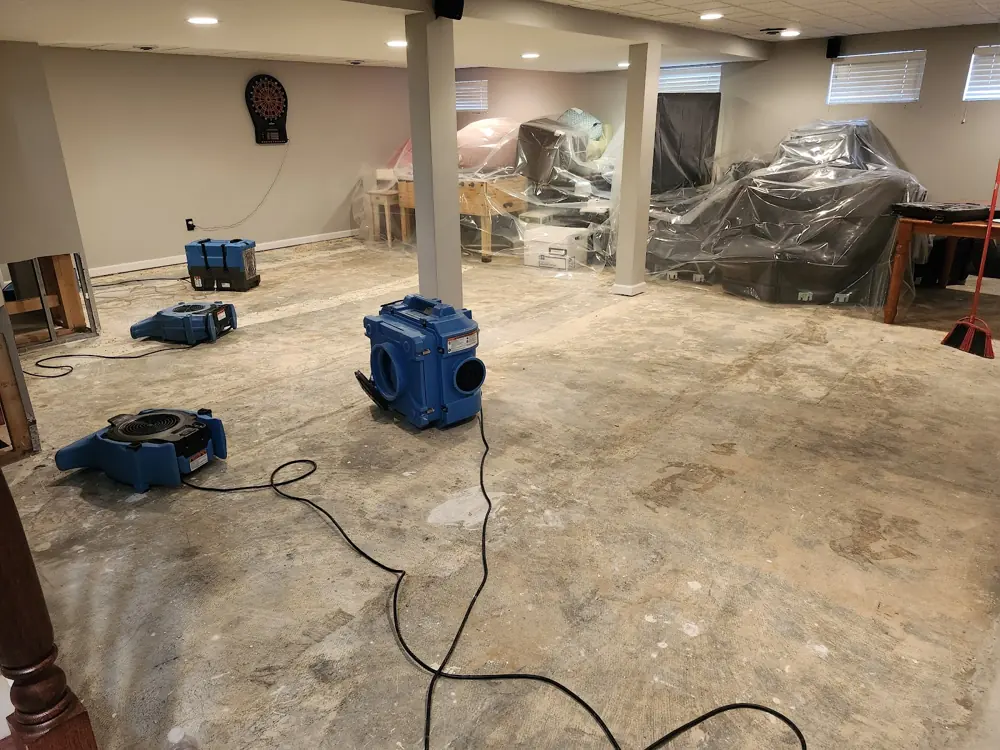
Sump pumps are less common in Houston than in cities with basements, but they still show up in below-grade garages, elevator pits, and some foundation drainage systems, and when one fails during heavy rain, water backs up fast. Crews extract and dry the space before it spreads further.

A crew typically arrives within about an hour to check electrical safety around the affected pump and drainage system before entering.
Submersible pumps and wet vacuums clear the standing water the failed system should have handled, working from the lowest point outward.
The failed pump, float switch, or discharge line is identified so the underlying cause is documented alongside the water damage.
Air movers and dehumidifiers dry the enclosed space, with moisture readings logged daily until the area returns to a normal range.

While help is on the way, these first steps, done only where it is safe, limit the damage and protect the insurance claim.
Shut the supply off at the source, or close the home's main valve if the source is not obvious. Stopping the flow limits the damage more than anything else.
Switch off electricity to the affected area, but only if the breaker can be reached without standing in or touching the water.
Get a crew dispatched right away. The sooner extraction and drying begin, the more flooring, drywall, and belongings can be saved.
Take photos and a short video of the water and the affected rooms before anything is moved, so the insurance claim starts strong.
Sump pump failure cleanup in Houston typically runs from about $500 to $3,500, depending on how enclosed the space is, how long the water sat before discovery, and whether stored items or finished surfaces were affected. A below-grade garage pump-out caught the same day sits on the low end, while an elevator pit or drainage system failure that ran for an extended period sits on the higher end. The pump or float switch replacement is typically a separate line item from the water damage cleanup itself.
Crews reach Houston, Harris County, and the surrounding Gulf Coast communities fast, from the Heights, Montrose, and River Oaks to West University Place, Bellaire, Pasadena, and South Houston. See the full list on the areas served across Houston page.
See all areas servedEvery loss is photographed, measured, and logged from the first visit, so the paperwork holds up with the insurance carrier.
Technicians follow recognized IICRC drying standards and prove it with daily moisture readings on Houston homes, not guesswork.
Emergency dispatch any hour of the day or night, with a real crew on the way across Greater Houston, not a callback in the morning.
A real crew dispatched any hour, not a callback in the morning.
Trained technicians following recognized IICRC drying standards.
Truck-mounted, portable, and submersible for any size loss.
The loss is documented and billed to the carrier directly.
No. Because most homes here are built on a slab with no basement, a traditional sump pump is uncommon. They mainly appear in below-grade garages, certain foundation drainage systems, or elevator pits and parking levels in townhome and high-rise properties.
A power outage during a storm, a worn or stuck float switch, or a pump simply being undersized for an unusually heavy downpour are the most common causes, often happening at the exact moment the system is needed most.
Submersible pumps and wet vacuums are brought in to manually clear the standing water while the failed system is assessed separately, so cleanup does not wait on the repair.
For a property that already relies on a sump pump for a below-grade space, a battery or water-powered backup can keep the system running during a power outage, which is often exactly when heavy rain causes the most risk.
Coverage varies by policy, and some homeowner policies require a specific sump pump or water backup endorsement for this kind of loss. Documentation of the failure and the resulting water damage is prepared to support whatever coverage applies.
Houston crews are on call 24 hours a day, local and fast, and can be on the way within the hour.
Call (346) 680-3171